
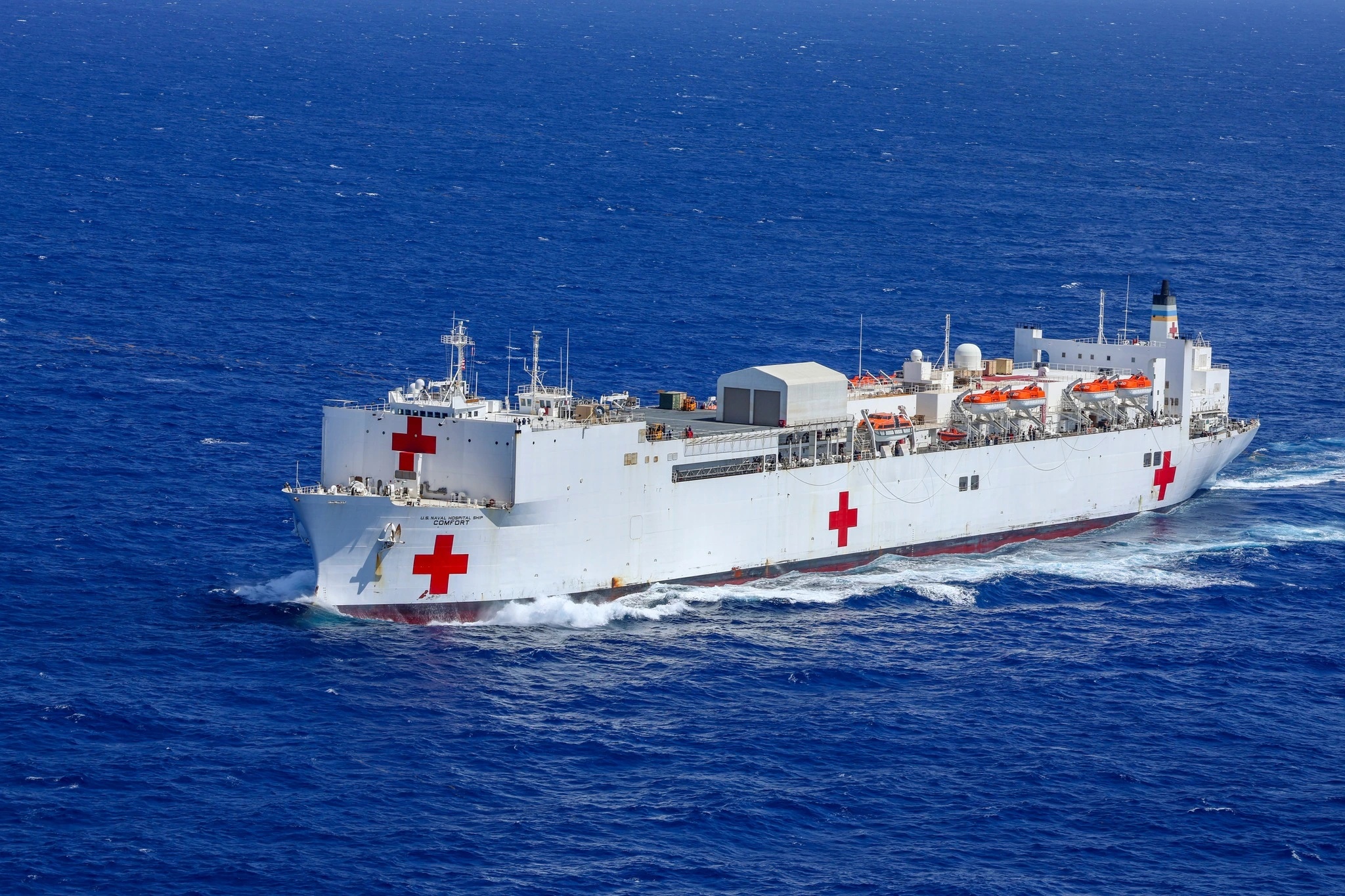
President Donald Trump announced on February 21, 2026, via his Truth Social platform that the United States will deploy a hospital ship to Greenland to provide medical care, claiming the mission will address needs for “many people who are sick, and not being taken care of there.”
The announcement came in a post stating: “Working with the fantastic Governor of Louisiana, Jeff Landry, we are going to send a great hospital boat to Greenland… It’s on the way!!!” accompanied by an illustration of the USNS Mercy (T-AH-19), one of the U.S. Navy’s two primary hospital ships operated by Military Sealift Command (MSC). Trump referenced collaboration with Louisiana Governor Jeff Landry, whom he previously appointed as a special envoy related to Greenland affairs.

The USNS Mercy, a 1,000-bed Mercy-class hospital ship commissioned in 1986, has been undergoing scheduled mid-term maintenance at Alabama Shipyard in Mobile, Alabama, since July 2025 under an $18.7 million contract that included drydocking and overhaul work. Recent AIS tracking data and shipyard announcements confirm the vessel remains docked there as of late January 2026, with maintenance potentially extending into mid-2026. Her sister ship, USNS Comfort (T-AH-20), arrived at the same facility around January 22, 2026, for a 102-day mid-term servicing contract valued at approximately $16.7 million, marking the first time in 30 years both hospital ships have been alongside each other at one yard.
This rare co-location at Alabama Shipyard highlights ongoing sustainment efforts for these aging vessels, which are critical for humanitarian assistance, disaster relief, and military support missions worldwide. However, the current maintenance status raises questions about immediate deployment feasibility, as neither ship appears ready for transatlantic transit to Greenland in the near term without accelerated work or alternative arrangements.
Greenland, a semi-autonomous territory of Denmark with a population of around 56,000, maintains a universal public healthcare system funded through Danish resources, supplemented by local facilities in Nuuk and other settlements. Danish officials, including the defense minister, quickly rejected the need for external medical assistance, emphasizing that Greenland’s healthcare meets resident requirements and no request was made for U.S. support. The announcement drew criticism online, contrasting Greenland’s system with U.S. domestic healthcare challenges and questioning the timing amid ongoing U.S. interest in the Arctic territory’s strategic value.
The proposed mission ties into broader geopolitical dynamics in the Arctic, where shipping routes, resource access, and military presence are increasingly contested. Hospital ships like Mercy and Comfort have historically supported global operations, including COVID-19 response in 2020 and disaster relief, but deployments require significant preparation, crew readiness, and diplomatic coordination—elements complicated by the vessels’ current yard period.
This development underscores logistical realities in U.S. naval sustainment, where scheduled overhauls at commercial yards like Alabama Shipyard ensure long-term readiness but can limit surge capacity during unexpected announcements. The situation highlights the challenges of aligning political rhetoric with operational timelines in maritime logistics for remote, high-latitude regions like Greenland, where ice conditions and distance add further complexity to any potential sealift effort.