
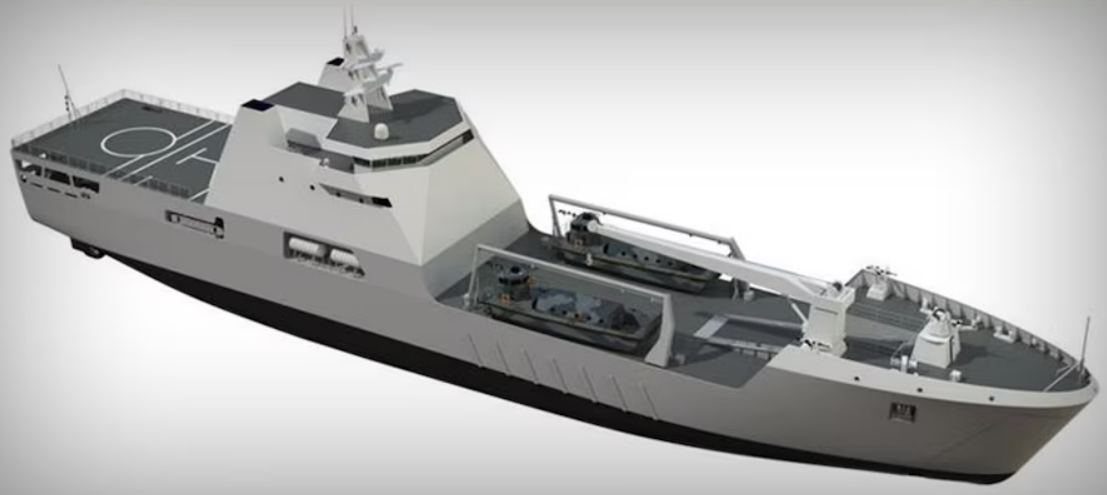
The U.S. Navy has selected Fincantieri Marinette Marine, its Wisconsin-based shipyard, to construct the first four Medium Landing Ships (LSM) as part of the Landing Ship Medium program, announced on February 18, 2026.
This decision follows the Navy’s issuance of a Request for Proposal (RFP) for a Vessel Construction Manager (VCM) to oversee the acquisition, accelerating delivery through commercial practices, enhancing cost control, and expanding the domestic shipbuilding industrial base. The contract award for the VCM is expected in mid-2026.
The announcement comes shortly after the cancellation of the Constellation-class frigate program at the same yard, providing a timely follow-on workload. Congress allocated an additional $800 million to support the transition to LSM production.
Bollinger Shipyards in Louisiana and Mississippi will also participate, having secured a prior contract in September 2025 for long-lead-time procurement and lead ship engineering design activities. For initial production, the VCM will manage construction at both Bollinger Shipyards and Fincantieri Marinette Marine, with Fincantieri tasked specifically to build four vessels. The VCM will later determine the strategy for awarding the remaining ships under the base contract, which authorizes up to nine vessels initially, toward a planned fleet of 18–35 ships.
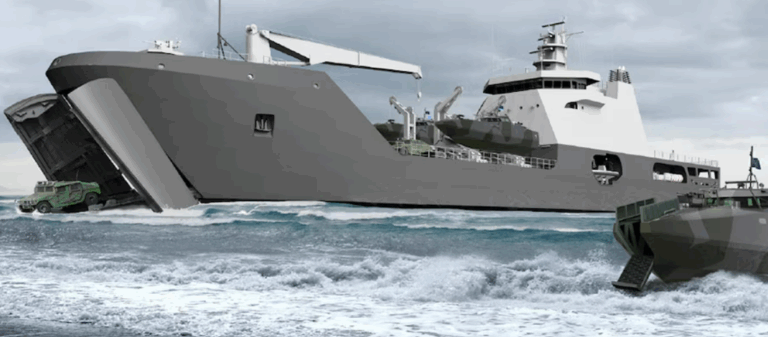
The LSM design is based on the proven LST-100 concept from Damen Naval in the Netherlands, selected to minimize technical risks, reduce construction timelines, and leverage an existing, mature platform. These mid-sized amphibious vessels bridge the capability gap between smaller landing craft and large multi-mission amphibious warships, enabling beachable operations for troop and equipment transport in contested environments.
The program supports the U.S. Marine Corps‘ distributed maneuver and logistics concepts, particularly in the Indo-Pacific, where expeditionary agility is critical for Marine Littoral Regiments equipped with anti-ship missiles and operating across island chains. LSMs will provide coastal mobility, sustainment, and rapid repositioning in scenarios requiring dispersed operations far from traditional bases.
This selection highlights adaptive strategies in U.S. naval shipbuilding amid industrial base challenges, ensuring workload continuity at key yards while prioritizing speed and reliability in delivering amphibious capabilities. The use of a proven foreign-derived design adapted for U.S. production demonstrates efforts to balance innovation with risk reduction in modern fleet expansion.